§ 01
Results, with the receipts.
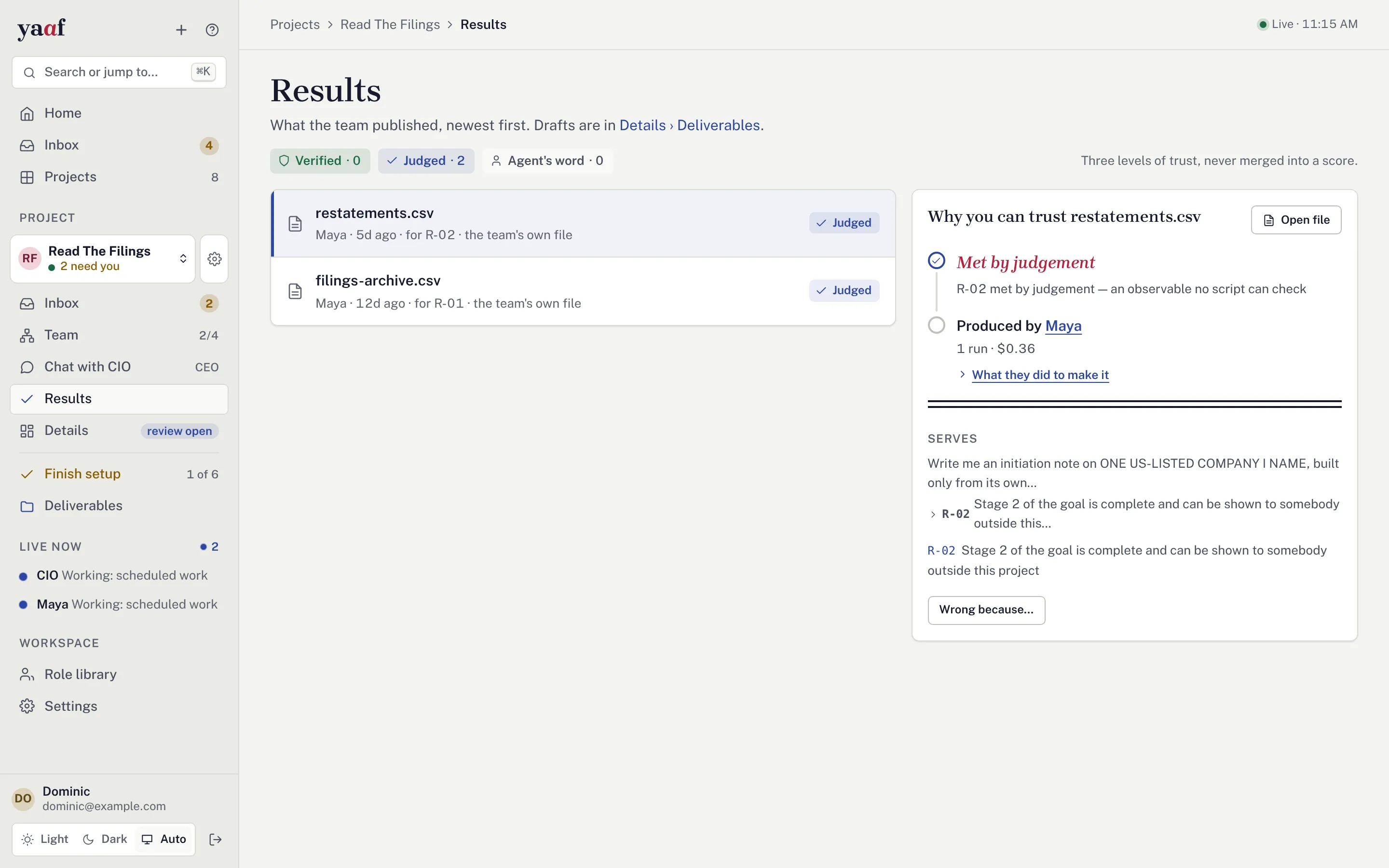
Every deliverable says who made it and who checked it. Verified by yaaf, not graded by the agent that wrote it, with the chain from your goal down to the task.
Open source · Apache-2.0 · your machine · your keys
yaaf runs a team of AI agents like a company you chair. The platform runs the tests, meters every dollar and holds the date. The rules live in the server, not the prompt, so you can close the laptop.
restatements.csv
Budget$412 / $500
Example receipt and budget, drawn the way the app shows them.
§ The rules
A confident answer is not a correct one, and one agent agreeing with another proves nothing. Each rule is a refusal enforced by the server. Break one and an agent gets a 403, not a stern reminder.
§ 01
Nothing counts as finished until yaaf checks it. The platform runs the test itself. An agent saying so isn't enough.
2,743 tests · “done” alone is refused
§ 02
Every run is metered, killed ones included. At the wall you set, the company pauses and tells you.
at the wall · the project pauses
§ 03
The finish date comes from measured pace. If it slips, you know, and new scope waits until you decide.
date slips · new scope frozen
§ 04
Risk and review seats can veto the work they check. The CEO can't fire the last one.
9 critic roles · the last one stays
The record behind every result
External evidence is fetched, hashed and snapshotted by the server, never taken at the agent's word.
Nothing closes without observed evidence. “Done” on its own is refused.
Critic seats can veto. A random sample of finished work is dealt to you to check.
Every decision, yours or the CEO's, is on the record with its reason and can be reversed.
§ The company
Describe the goal. yaaf argues with it until it’s testable, then hires a CEO and the seats it needs, each on its own model and harness. No single seat needs to know everything.
38 roles17 ready-made teams6 harnesses23 providers
The role library · Every harness and provider · Why we built it
Chair
Set the goal, the budget and the date. Own the rules.
pause · stop · veto · amend
CEO
Plans the work, hires the teams, and kills what the evidence kills.
can't edit the rules or invent a date
Seat
Answers the question its task states, from what it actually read.
a claim needs fetched evidence
Seat
Builds the smallest thing that makes the success test pass.
done when the platform ran the test
Critic
Tries to break the team's work before anyone outside does.
veto · the CEO can't fire the last critic
Critic
Reads the work before it ships, and can say no.
veto on the work it checks
§ How it works
Say it in the dashboard, or in the Claude window you already have open.
Tell the Founder what you want. It interviews you until nothing is assumed, then drafts the goal, the teams, the budget and the date, hiring from 38 job descriptions.
The goal is graded against the ten things a goal needs to work: a finish line, who it's for, what doesn't count. Before anything exists.
The whole company runs on scripted agents first: where it would stall, what it would cost, how often it would stop and wait for you.
A CEO, its teams, a budget, a delivery date and a Slack channel each. Then it works for weeks.
§ Your authority
Some chairs approve every important decision. Others set a goal and a budget and let the CEO run. Both belong in yaaf.
Supervised · right for your first project
7 stops
In a real rehearsal of a red-team project, the company stops and waits for you 7 times. Each one is a morning it sits idle until you open the app.
Set rule by rule
4 stops
In a real rehearsal of a red-team project, the company stops and waits for you 4 times. Each one is a morning it sits idle until you open the app.
Set rule by rule
3 stops
In a real rehearsal of a red-team project, the company stops and waits for you 3 times. Each one is a morning it sits idle until you open the app.
Set rule by rule
3 stops
In a real rehearsal of a red-team project, the company stops and waits for you 3 times. Each one is a morning it sits idle until you open the app.
Set rule by rule
0 stops
In a real rehearsal of a red-team project, the company never had to wait for you. You read what the CEO decided afterwards, and can reverse any of it.
Autonomous · where a new project starts
0 stops
In a real rehearsal of a red-team project, the company never had to wait for you. You read what the CEO decided afterwards, and can reverse any of it.
plan_authorityYouYou accept each requirement the CEO proposes.
CEOThe CEO accepts its own plan. The plan gate still runs the same arithmetic.
commitment_authorityYouYou sign the delivery date, and only you move it.
CEOThe CEO adopts the platform's projected date. It never writes one.
scope_authorityYouCutting, reopening and restaging work is yours.
CEOThe CEO re-scopes on the record. Every change is reversible.
verdict_policyYouResults no script can check wait for your judgment.
CEOThe CEO judges them, and every self-judged close is disclosed to you.
capability_authorityYouYou grant every credential.
CEOThe CEO re-scopes credentials it already has across its team.
Never moves, at any setting
Delegation changes who makes decisions. It does not remove accountability.
These are five real switches in the project's constitution, which no agent can edit. How the switches work
§ The real thing
Check in when you want. The company keeps working when you don't.
Every deliverable says who made it and who checked it. Verified by yaaf, not graded by the agent that wrote it, with the chain from your goal down to the task.
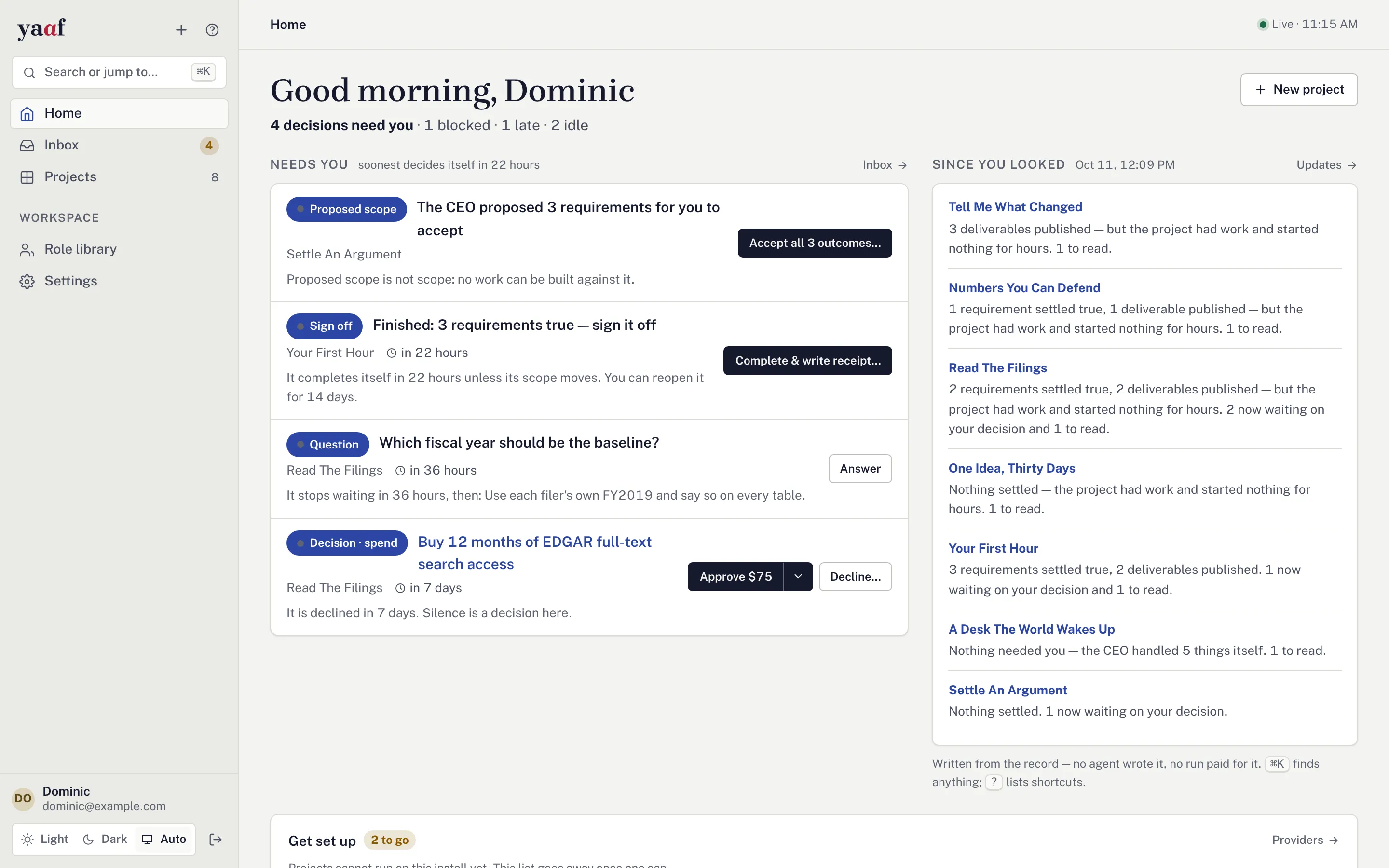
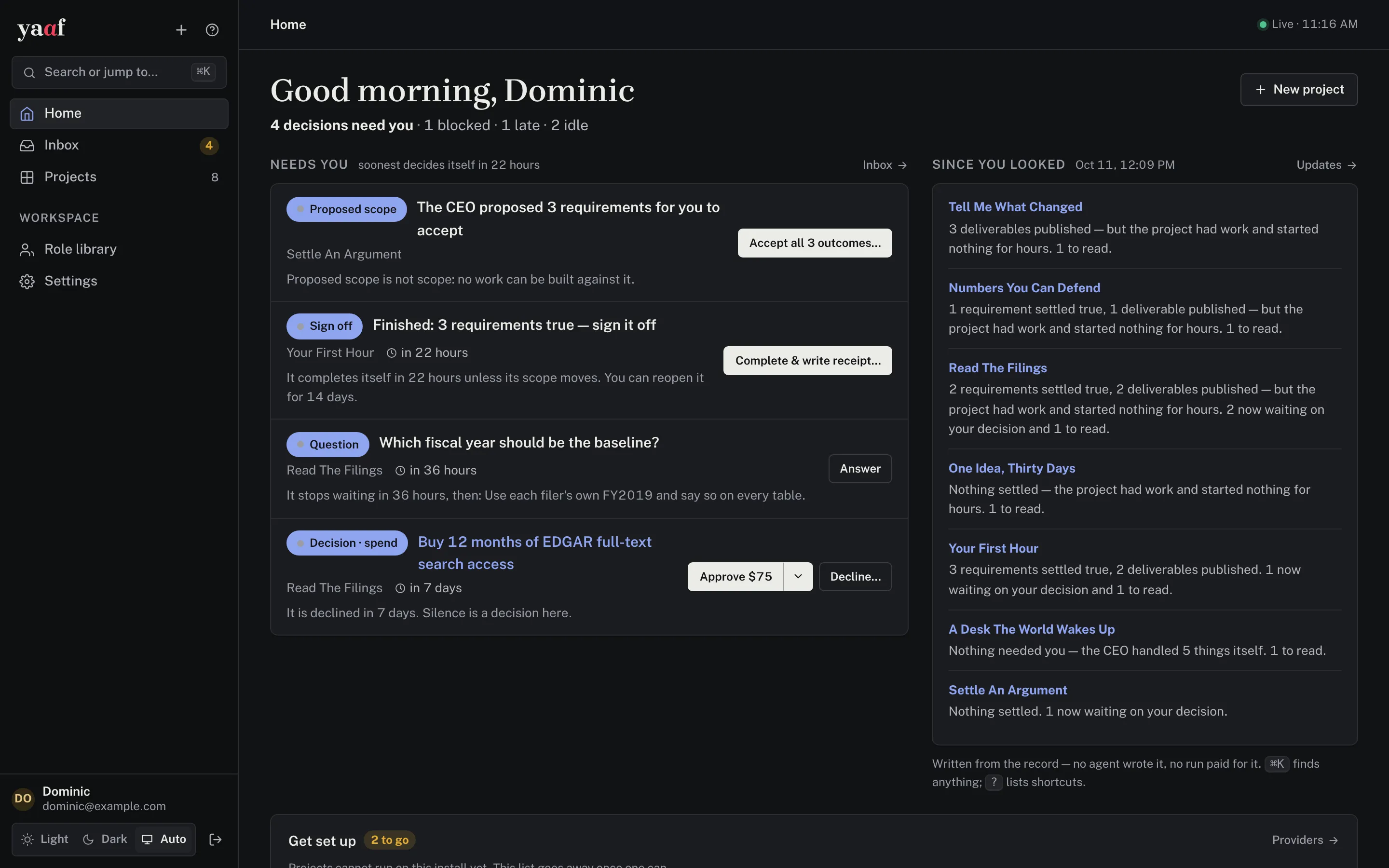
The app opens on what needs you, soonest consequence first. Each item says what happens if you do nothing. Decide in one click, snooze it, or undo it.
The org chart shows who reports to whom, what each seat is doing right now, the model it runs on and what it has cost this month.
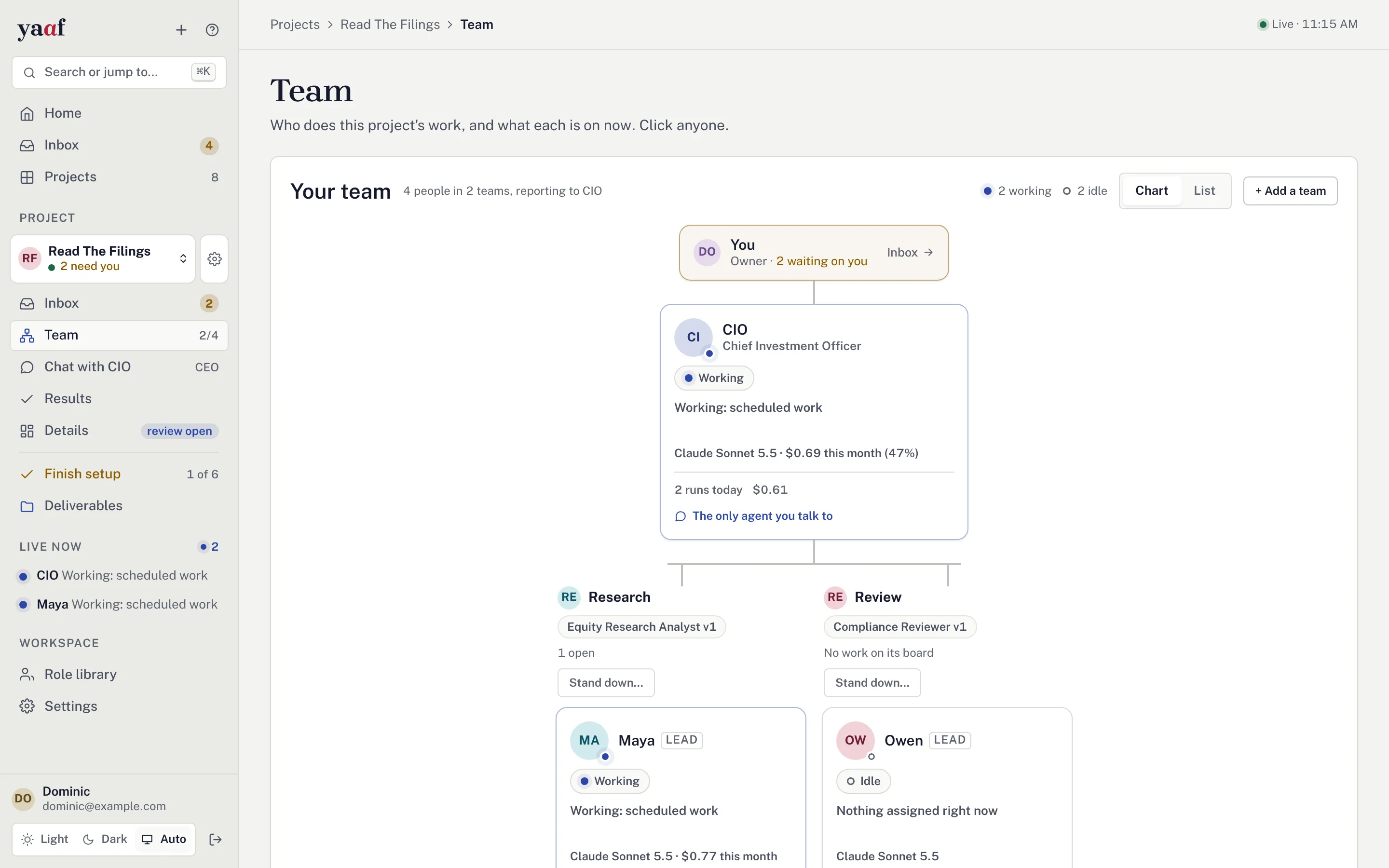
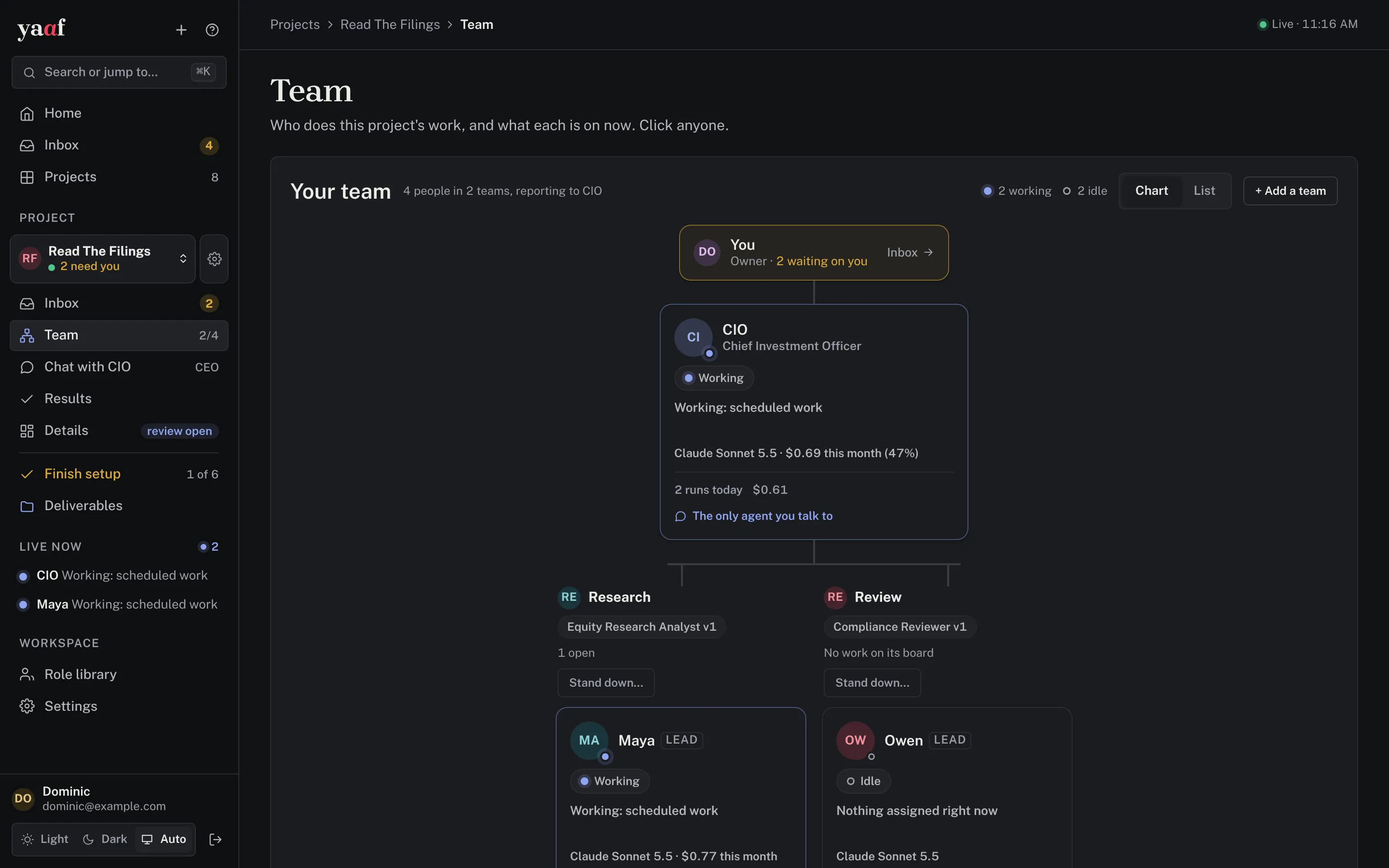
Ask why the date moved. Tell it to stop buying data and find the free route. Every answer shows what the team did to get there.
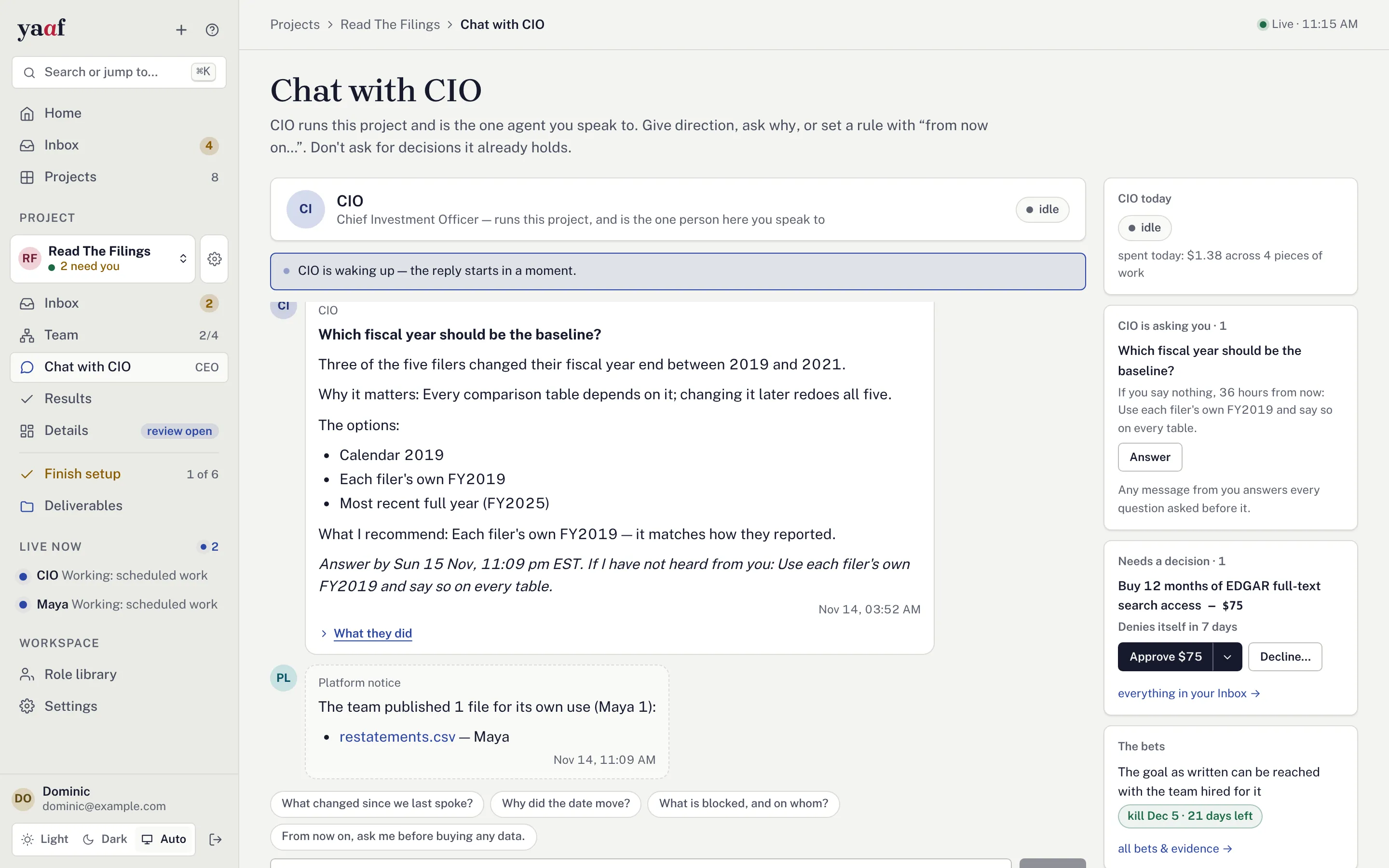
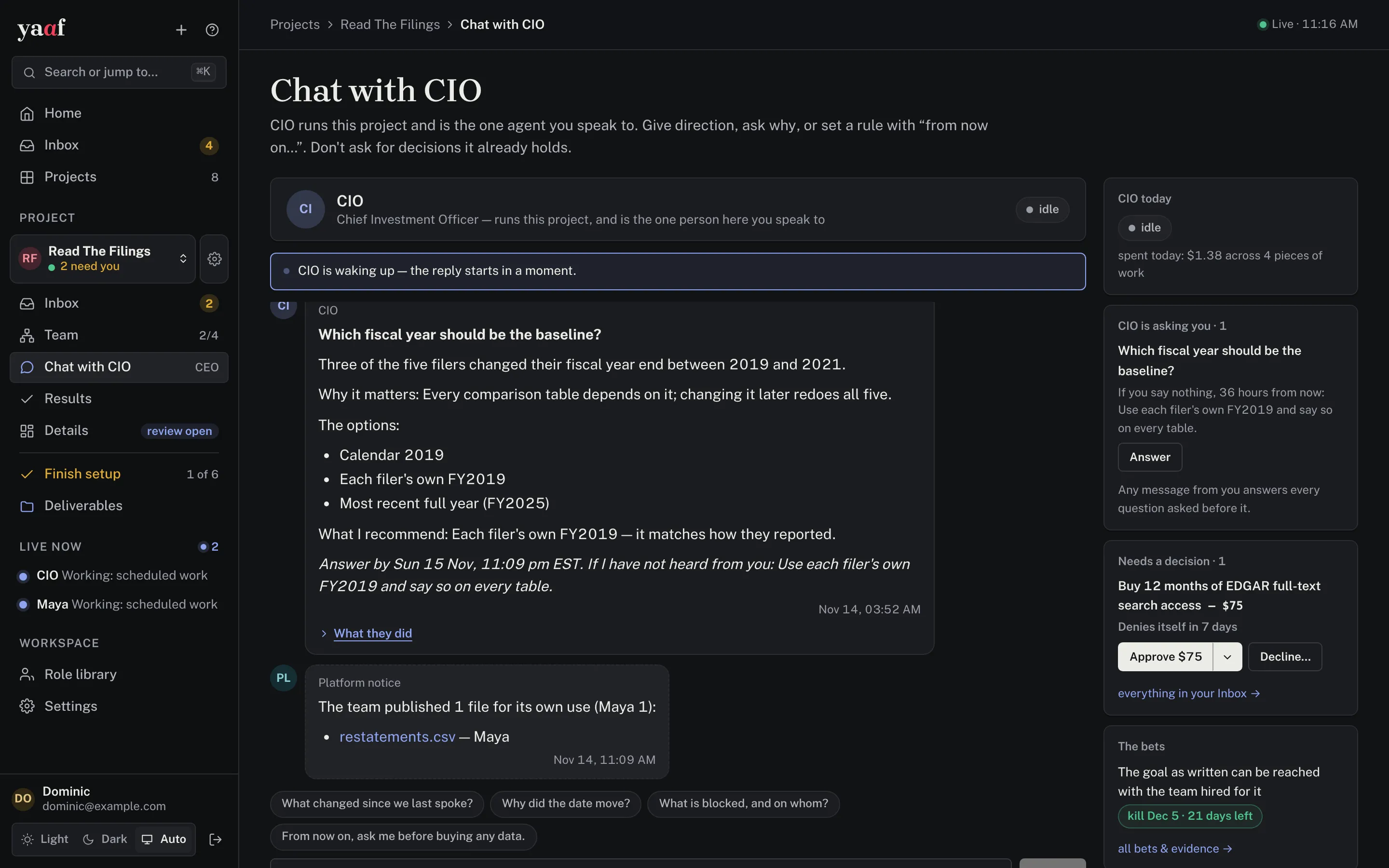
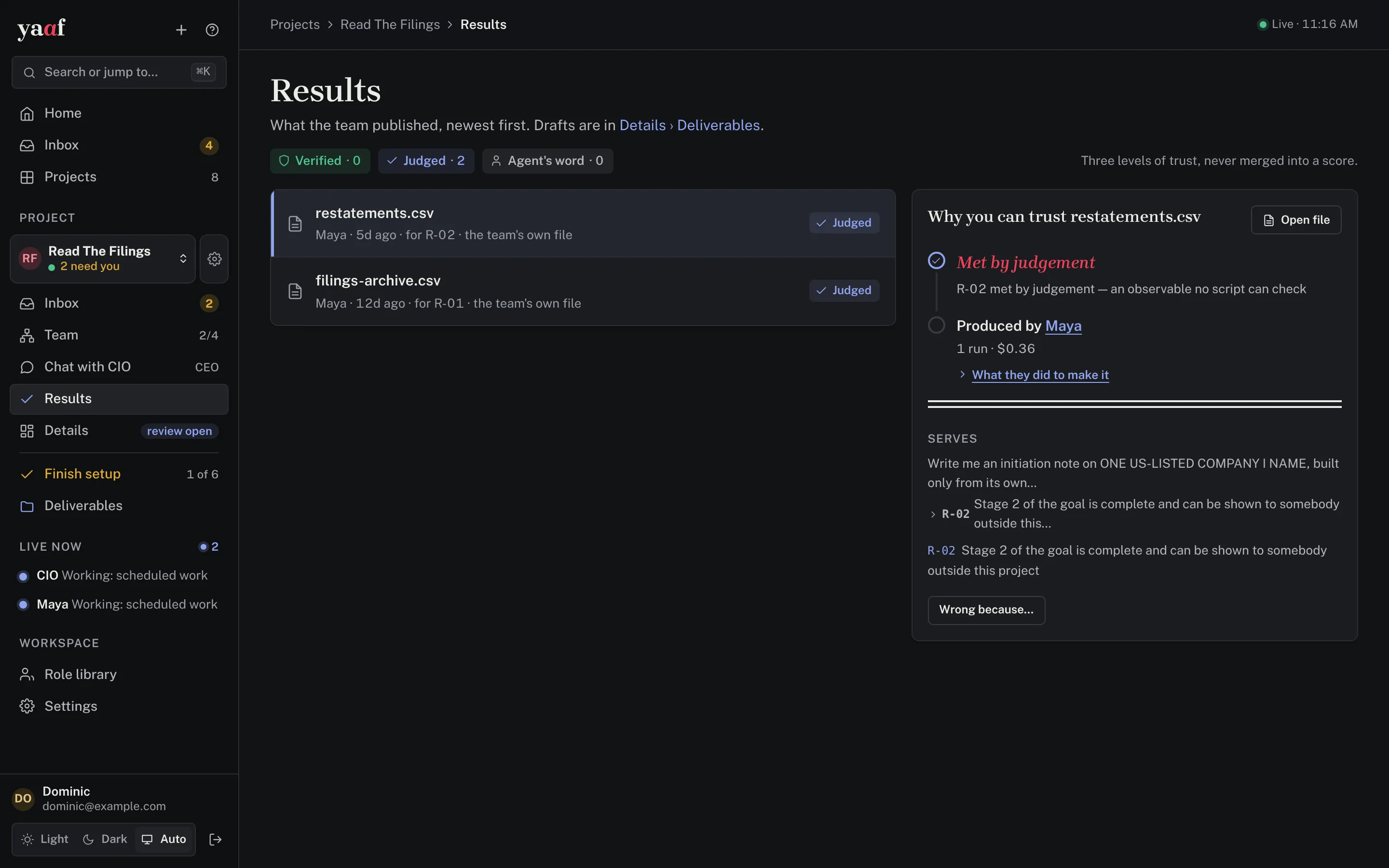
The real product, on demo data. Check in from the app, the terminal (yaaf status), Slack, a daily letter, or Claude over MCP.
§ The harness, one level up
Claude Code, Codex, Gemini CLI and OpenCode give one model a loop and tools. yaaf is what's around them: the company they work for.
§ 03yaaf, the team harnessDrives the company: who's hired, what's next, what it costs, when it's due, and whether it's really done. The rules live in the server, not the prompt.
§ 02The agent harnessDrives one model: its loop, its tools, its context. Claude Agent SDK, Claude Code CLI, yaaf agent loop, Codex CLI, Gemini CLI, OpenCode CLI. Every seat on the chart runs in one.
§ 01The modelThe weights. Claude, GPT, Gemini, DeepSeek, Mistral, Kimi, a local model. 23 providers.
“A harness is transport. It decides how a model is driven, never what the model may do.”
That line is from yaaf's own design. What a model may do is decided in one place, the server, and every rule is a refusal. Every harness and provider
§ What becomes possible
Some companies exist for an afternoon. Others run continuously. The last column is a direction, not a feature.
A project that delivers one result and stops: a question answered with sources, a fix, a report.
A project that keeps running: woken by the world at 3am, a standup each morning, a register that stays current.
Today a crew can test one idea for thirty days. Organizations that run a business with extensive autonomy, inside the boundaries their owner sets, are where this is going. We aren't there yet.
Each night, a crew picks the most useful fix in your repo and opens a pull request.
Analysts read a company's filings and write the report. Every claim links to its source.
Thirty days to prove real people want it, or a clear reason to stop.
Writers and an editor publish on your topic and learn what readers respond to.
A developer, a designer and a tester build it together. You can read how they decided.
What changed in the things you depend on. Nothing you already know.
Open source
Fork it. Change anything. No account to make, no hosted version, no telemetry.
Your machine
One command starts it on your laptop; one script puts it on a server. Projects, files and keys stay with you, and agents pay your provider directly.
Honest about cost
Scripted agents show where it would stall and what it would cost. It is not for quick tasks.
Early days: pre-1.0, 643 commits since August 14, built in the open with Claude Code. Source on GitHub · Models and keys